nested-EAGLE
EAGLE currently includes a prototype nested-EAGLE model trained with global GFS data together with HRRR data over the Contiguous United States (CONUS).
This model builds on previous work from Met Norway (Nipen et al., 2024, arXiv:2409.02891) by combining lower-resolution global data with higher-resolution data over an area of interest.
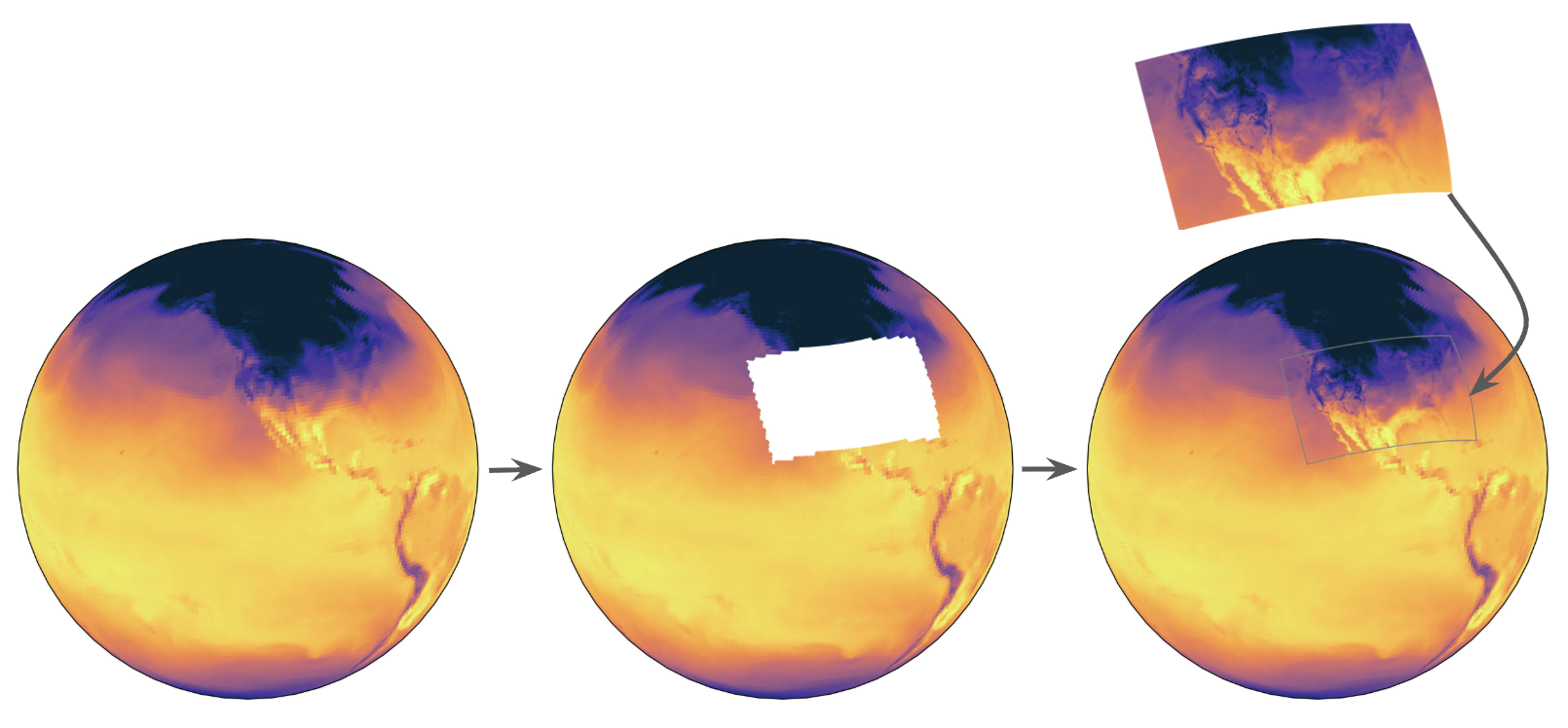
Overview of the nested-EAGLE domain
nested-EAGLE configurations were provided by Tim Smith at NOAA Physical Sciences Laboratory.
Training Data
The nested-EAGLE training dataset combines regridded global and regional forecast data.
At a glance:
GFS is conservatively regridded to 1 degree.
HRRR is conservatively regridded to 15 km.
The training period spans
2015-02-01T06through2023-01-31T18.The validation period spans
2023-02-01T06through2024-01-31T18.The testing period spans
2024-02-01T06through2025-01-31T18.
Category |
Fields |
|---|---|
Prognostic |
|
Diagnostic |
|
Forcing |
|
The vertical levels used in the dataset are 100, 150, 200,
250, 300, 400, 500, 600, 700, 850, 925, and
1000.
Model Architecture
The nested-EAGLE model uses the following architecture:
Encoder and Decoder: Graph Transformer
Processor: Sliding Window Transformer
Latent space is a 4x coarsened data space
The graph configuration connects targets to nodes through nearest neighbors in
the encoder and decoder, with encoder_knn=12 and decoder_knn=3.
The latent mesh is four times coarser than the native data resolution.